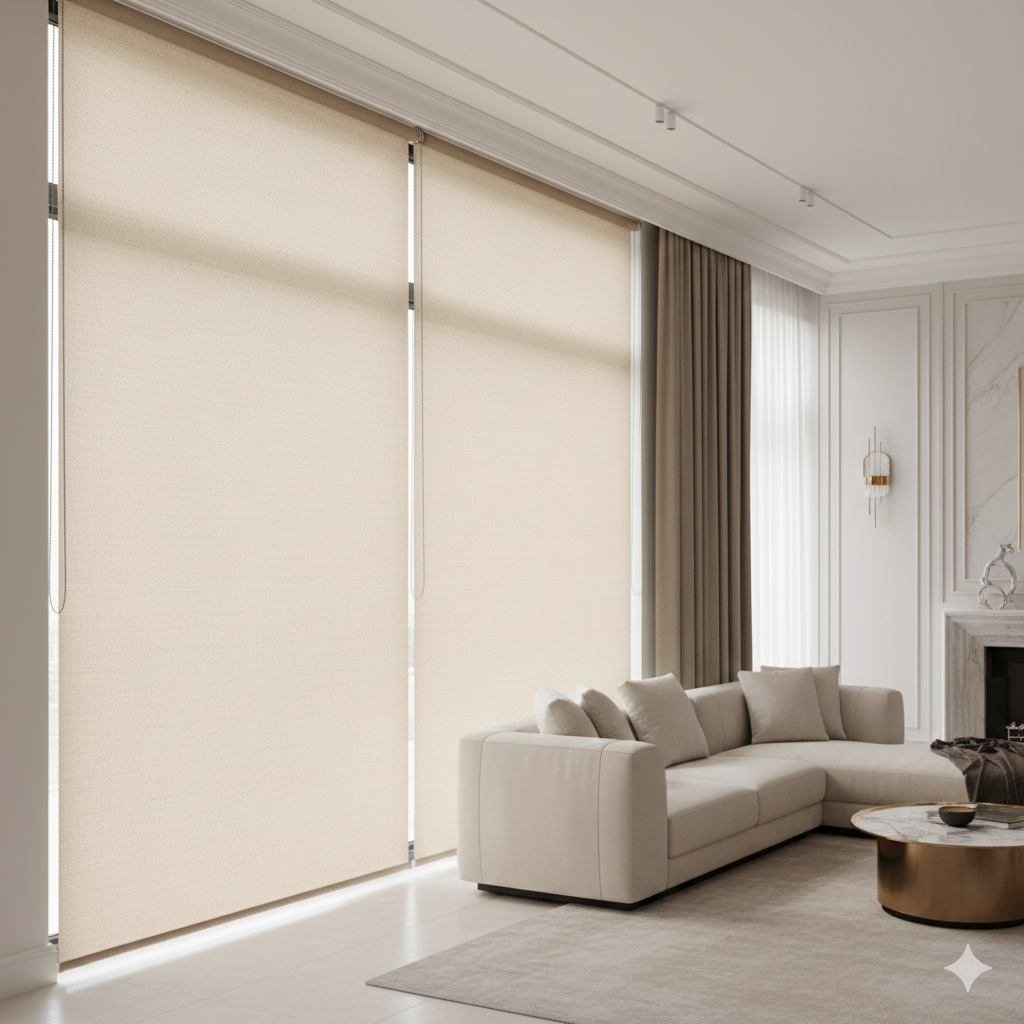
PREMIUM ROLLER BLINDS
Precision engineering. Timeless elegance. Exceptional value.
Ready to Transform Your Space? Get a free, no-obligation quote for your custom roller blinds. Our experts will help you choose the perfect fabric, openness factor, and operation style.
Key Features
Multiple Operation
Modes
Light
Control
Premium
Style Option
Energy
Effieient
Space-Saving
Design
Roller Blinds
Saffron Blinds presents an extensive collection of premium roller blinds, thoughtfully designed to elevate any interior. Our range features high-performance Glass Fiber and PVC Screen fabrics with openness factors ranging from 3% to 10% — giving you precise control over natural light, glare reduction, and outward visibility.
Whether you need complete darkness for restful sleep, subtle light diffusion for a productive workspace, or UV protection while preserving your view, we have the perfect solution.
Our collection includes Blackout fabrics for bedrooms and home theaters, Dim-out options ideal for AV rooms and conference spaces, and elegant Translucent fabrics that complement any décor style.
Every roller blind is custom-made to your exact window measurements and finished with durable, child-safe components for lasting everyday performance. Our team helps you compare fabrics, openness factors, and operation styles so you choose the right roller blinds for each room.
To understand how roller blinds compare with other window covering options, see this helpful overview of window blinds on Wikipedia. Book a free measurement visit today and let our specialists recommend the perfect roller blinds for your home or office.
Residential Spaces | Commercial & Corporate | Hospitality & Healthcare
Our Roller Blinds Colletion
Roller Blinds
Pleat Roller
Roller Blinds (Contract A)
Roller Blinds (Contract B)
Operation Types
Manual Operation
- Smooth chain operation with child-safe options.
- Self-locking mechanism holds position at any height.
- Durable metal components built for 50,000+ cycles.
- Silent operation — no clicking or grinding sounds.
Motorized / Electric Operation
- Remote control operation — RF or infrared options.
- Smart home integration (Alexa, Google Home compatible).
- Timer and schedule programming.
- Group control for multiple blinds.
- Battery backup options available.
Fabric & Style Options
For light control, choose from Blackout fabrics that block 100% of light for bedrooms and home theaters, Dim-out fabrics that block 95-99% of light ideal for conference rooms and AV areas, or Translucent fabrics that softly diffuse natural light while maintaining daytime privacy.
Style configurations include Classic with standard exposed roller tube for economical everyday use, Fascia featuring a sleek aluminum cover that conceals the mechanism for a contemporary finish, Cassette with a fully enclosed headbox that protects fabric from dust and adds premium aesthetics, Side Channel where fabric runs through guided tracks eliminating all light gaps for complete blackout, and Day & Night dual roller systems that combine sheer and opaque fabrics on a single bracket for versatile light control throughout the day.
FAQ
Sheer (or screen) fabric is woven with tiny openings that filter daylight and give a soft glow while keeping some outward view, but it offers limited privacy after dark. Dim-out fabric is more densely woven to cut most of the light and give good daytime privacy without total darkness. Blackout fabric has a coated backing that stops light passing through the fabric itself, so it's the choice for bedrooms and media rooms.
The blackout fabric itself blocks light, but a standard roller sits in front of the window so a little light still leaks around the edges and through the gap between the fabric and the wall. For near-total darkness you need a side-channel or cassette system that closes off those gaps. On a plain roller, expect a thin light line down the sides.
A roller blind is a single piece of fabric wound around a tube at the top, with a control on one side that turns the tube to raise or lower it. Because the fabric simply rolls up onto the tube, there are no slats, cords between vanes, or folds, which keeps the look clean and the operation simple. You can stop it at any height to set how much window is covered.
During the day, sheer and dim-out fabrics give you privacy from outside while still letting light in, because the brighter side is outdoors. At night, when the light is inside, sheer fabrics can let silhouettes show through, so a dim-out or blackout fabric gives better evening privacy. Choosing the right fabric for the room is the main way you control this trade-off.
Yes, rollers are one of the easiest blinds to motorise because the motor simply replaces the manual control inside the tube and turns it. Many systems run on a rechargeable battery so no wiring is needed, and they can be operated by remote or, on some systems, an app or voice assistant. Whether an existing roller can be retrofitted depends on the tube size and whether it was built for a motor, so it isn't guaranteed on every blind.
They can be, but a standard chain-operated roller has a looped cord that is a strangulation hazard for young children unless it's secured. Safer options include a cordless spring mechanism, a tensioned chain guide fixed to the wall, or a motorised blind that removes the cord entirely. For homes with small children, a cordless or motorised roller is the safest choice.
Rollers work well on large windows, but a single fabric panel has a practical width limit because very wide fabric gets heavy and can sag or deflect on the tube over time. For very wide openings the usual solution is to split the run into two or more blinds on separate tubes sitting side by side. The exact safe width depends on the fabric weight and tube diameter, so it's worth confirming for your specific window.
For routine care, lower the blind fully and wipe or dust the fabric with a dry cloth or a vacuum brush attachment. Most light marks come off with a damp cloth and mild soapy water, blotting rather than scrubbing so you don't damage any coating. Avoid soaking blackout or coated fabrics, and let the blind dry fully before rolling it back up.
The fabric and tube are generally low-maintenance, and the part most likely to wear is the operating mechanism, such as the chain clutch or, on a motor, the battery. Strong direct sunlight can fade some fabrics over years, and very humid rooms like bathrooms suit moisture-resistant fabrics better. Operating the blind smoothly rather than yanking the chain helps the mechanism last.
Rollers are the simplest, with one flat fabric that rolls up, giving a clean look and easy operation but less fine light adjustment than slatted blinds. Venetians use tilting slats for precise light and view control, Romans fold into soft fabric pleats for a softer look, and verticals suit very wide windows and sliding doors. Rollers are usually the most economical and easiest to clean, while the others trade simplicity for more styling or adjustment.
It depends entirely on the fabric: sheer screen fabrics keep a degree of outward view because of their open weave, while dim-out and blackout fabrics are designed to obscure the view for privacy. If keeping a view is important to you, choose a screen fabric and accept that it offers less privacy after dark. There's no roller fabric that gives both a clear view and full blackout.